
With a heavy heart, I leave Rio on my first night bus on the continent. The night buses here have different levels of comfort: there are those with regular seats (the semi-leite), with seats that recline 150 degrees (leite) and lie flat at 180 degrees (cama). You can pay extra for an “individual” seat, so you don’t have anyone next to you. I decide to make my first experience a positive one and take a leite individual seat. I take the first one in the row, so that no one in front of me reclines their seat. I find that so claustrophobic, as if you have no room to breathe, let alone move. I sleep most of the journey, but wake up with a start when someone seems to be leaning over me. He sees that I’m awake and quickly grabs a phone. I find this behaviour strange and hold on to my rucksack extra tightly. I suspect he would have stolen from me, but I had some very good guardian angels. Around 9 a.m., more than two hours later than planned, we arrive in an old mining town in the state of Minas Gerais called Ouro Preto. Minas is known for its mines (minas) and Ouro Preto is one of the villages where there was a kind of “gold rush”. Mining still takes place in the area and you can buy many precious stones and gold in the town. Precious stones from here are often shipped to the diamond district in Antwerp and the sellers all know the name of the town.
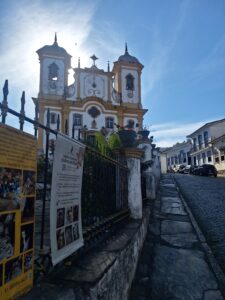
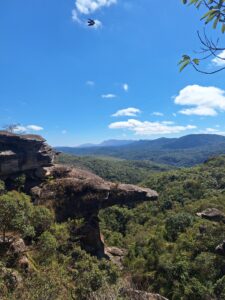
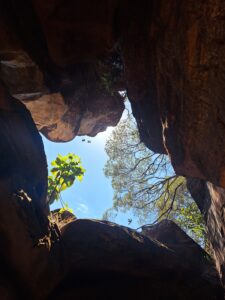
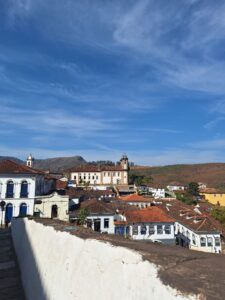
The town is built in a hilly landscape and is very similar to villages in Portugal. On the first day, I explore the town and the local museums, and on the second day, I take a trip to famous waterfalls in the area with an electrician from Barcelona. The electrician has roughly the same budget as me, but allocates it differently. The night before, I noticed that he never orders drinks, only food. After visiting the waterfalls, which were frankly a bit disappointing, we walk into town and I suggest we go out for dinner at a nice local restaurant with a view of the hills. The dishes cost 70 reais, about 13 euros. But the electrician didn’t want to spend that much on food, so he dragged me to a local canteen for a prato principal, the local bean-rice-meat combo that you can eat every day, for 35 reais. It was tasty, but it taught me the lesson that I travel a little differently. For me, experiences are important and I’m willing to pay for them. Minas is the province known for its gastronomy, and I want to experience that part of the culture when I’m there. The electrician only wants to do “local” things, which to me is another way of saying only do the cheap things. Because the fact that the restaurant exists and is full of local middle-class Brazilians confirms to me that “local” can have very different meanings.
In the afternoon, I take the bus to Belo Horizonte, the capital of Minas. Because it is holiday season, Ouro Preto is quite empty and many restaurants and bars are closed. That is why I only stayed there for two days and spent more time in my beloved Rio de Janeiro. I arrive at the local bus station (rodoviaria) and walk to my hotel. The neighbourhood is rough, with many beggars, homeless people and street kids. I enter my hotel and at the same time a man walks out with a prostitute to smoke a cigarette. Shit, where have I ended up? I have never felt so unsafe in Brazil as I do in this city. After the receptionist gives me my room key, I step into the lift. First bars close, second bars close, lights come on and I press the button to go up. It’s an old lift where you have to keep the button pressed and aim carefully to stop at the right moment to step out of the lift at about the same level as the floor. At night, I fall asleep to the sound of samba in the background from a big party in a club located in the patio behind the hotel.
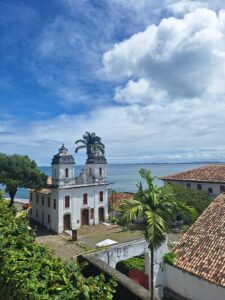
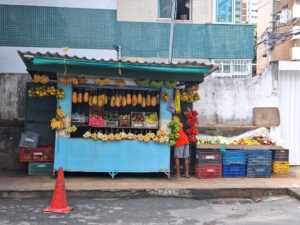
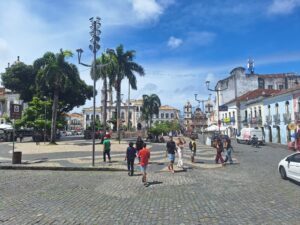
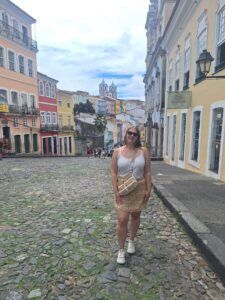
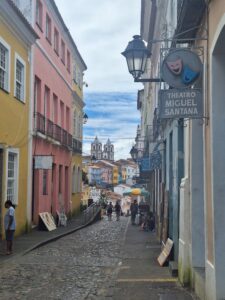
The next morning, I get up at 6 a.m. to catch an early flight to Salvador, or so I thought! At the airport, I try to check in my hand luggage for free because my large rucksack is actually too heavy and awkward. I go through everything and weigh it all to end up with exactly 12 kg in my large rucksack. Once checked in, I go to the gate and wait patiently. The flight is delayed and my connecting flight is rebooked. I want to board the plane but am stopped by an employee. ‘Yasmine?’ ‘Yes, that’s me.’ ‘You have been rebooked on a direct flight to Salvador. You need to collect your luggage from baggage claim and check in again.’ At first, I am a little sceptical, but eventually I collect my luggage and check it in again for the second flight. Once at the boarding gate, I am taken out of the queue again. ‘Yasmine?’ ‘Yes, that’s me.’ ‘You can’t take this flight because there’s a problem with your hold luggage. You need to go to baggage claim and your flight will be rebooked onto the next flight.’ Mierda! What is this now? By now, I am frustrated and trudging through the airport, stomping my feet. I suspect that this was also the problem the first time, but the steward did not have a good enough command of foreign languages to tell me. I shed a few tears (of course) out of frustration and exhaustion and have to check my bag in again. This time, I read all the fine print about what is and isn’t allowed in checked baggage. No deodorant, no razors, no phones or other electronics, and all the other usual things. At the gate, I ask if everything is okay, because I don’t want to miss my third flight of the day. Finally, I am on a plane, 8.5 hours after arriving at the airport. Once in Salvador, I take an Uber and arrive at my hostel in the dark. I meet a friend from Rio there and we catch up on the past two weeks. The atmosphere at the hostel is a bit strange and cliquey, so I decide to call it an early night and go to sleep at 10 p.m. In the following days, I visit the beach and the centre of Salvador, an old neighbourhood called Pelhourino. It reminds me a lot of Cartagena, although Cartagena is flatter and better maintained. Salvador only started maintaining and renovating buildings for tourism purposes 30 years ago. It is a city with many people of African descent and you can see the roots of their ancestors everywhere around you; in the food, the music, the dances, clothing, colours.
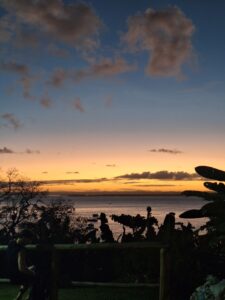
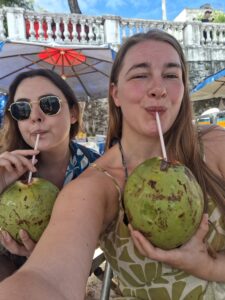
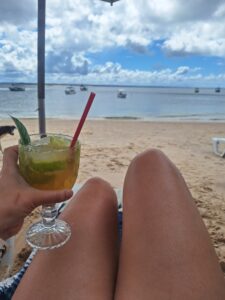
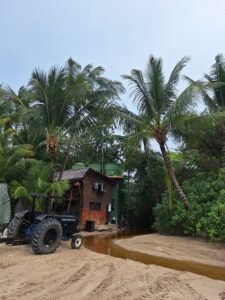
After three days in Salvador, I am ready for new places and take the catamaran to Morro de Sau Paulo, a beautiful paradise island off the coast of Salvador. On the ferry, I befriend a girl I had met earlier in Salvador. Her name is Luisina and she is from Argentina. Everywhere I go, I seem to befriend Argentinians, haha! We spend the day together on the beach and watch the sunset. The beaches in Morro have fine, light-coloured sand and the sea has different shades of light blue water. You can see the bottom of the sea through the water on most beaches, it’s so clear. I also talk to some girls from my hostel, who are all from Sao Paulo. Despite the language barrier, we joke around and say we’ll go out in the evening. Around 8:30 p.m., all my new friends go to take a shower, and I decide to take a short siesta in my party outfit. Around 1 a.m., I wake up confused and look around me. I see some of the girls sleeping and some beds still empty. I fear that not much more will happen tonight. The next day, Luisina and I explore the natural pools at one of the more distant beaches and meet a friend I made in Salvador, another young guy from Barcelona. He had waited for me to go partying, but in the end decided to go anyway. It was a fantastic night and he danced with at least 10 girls. Hey, what a shame I missed the party! Lesson learned, I’m not doing any more siestas after 7 p.m. I go for a coffee in the evening and listen to samba with the Brazilian girls. The samba in Salvador is different from that in Rio; in Rio there is more melody and everyone dances, while in Salvador the samba has more percussion and a more complex score. This makes it more difficult to dance to and it becomes more of a type of music that you sing along to. We end up at a local club called Clandestino. But I find the atmosphere a bit strange and decide to go to bed around 1 a.m. On my last full day in Morro, Sarah (Brazilian) and I explore Gamboa beach. A beautiful beach with clear blue water and a nice atmosphere. I teach Sarah and Anna Dutch words such as “hey hey”, “thank you”, “cheers” and “bye”. Hey hey becomes our personal inside joke, along with the fact that no one wants to believe that I pay with a debit card and not a credit card. The rest of my time in Morro and Salvador, I enjoy Sarah and Anna’s company and we spend every minute we can on the beach.
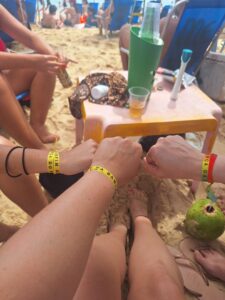
Together with my jar of Pasta Dagua (a Brazilian remedy for sunburn – you can guess what happened) and a bracelet with three wishes (a tradition in Bahia), I board the plane to Sao Paulo. This marked my farewell to the girls and the beaches, because for the next few months I will be in the Andes, where 20 degrees is a luxuriously warm day. Brrr! With different landscapes, different goals and a completely different rhythm of life. But first, three days in Sao Paulo, where I have to do some paperwork and process everything that happened over the past month.