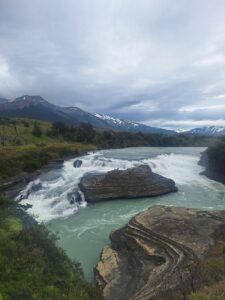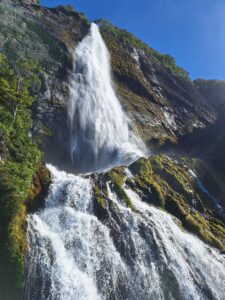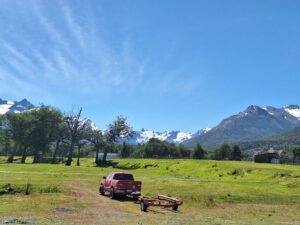
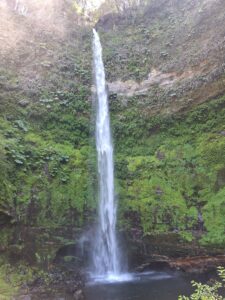
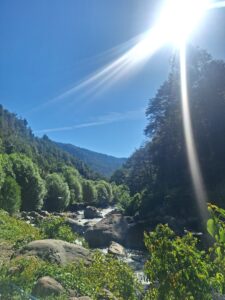
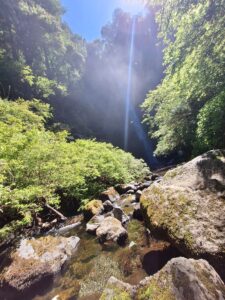
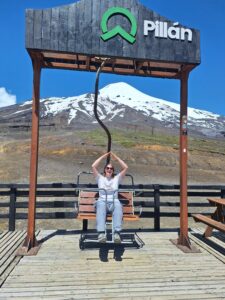
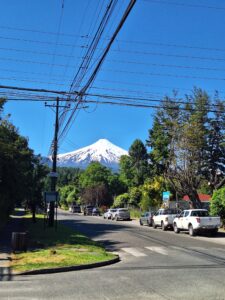
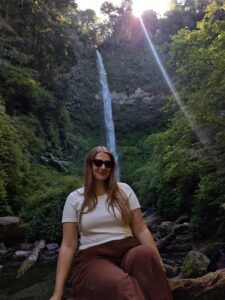
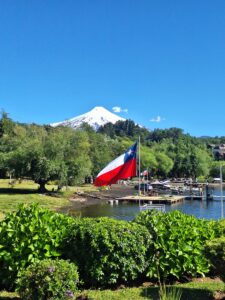
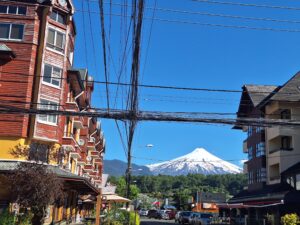
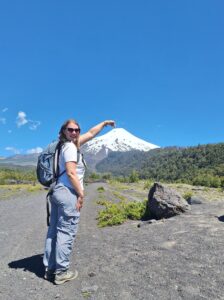
My Patagonia chapter begins in Pucon, on the northern border of Patagonia. It reminds me of Switzerland: beautiful high mountains with rolling hills in front of them, lots of trees and cows in the (alpine) meadows. The houses in the village are made of wood and resemble old-fashioned Austrian chalets, which have been given a lick of paint and some TLC. On my first day, I go with some Brits to see a large waterfall, in preparation for the big trek across the volcano the next day. When we reach the bottom of the waterfall, the Brits go swimming in the ice-cold water. Giant leaves grow on the cliffs next to the waterfall. I reckon you could use one of them as an umbrella. We walk down the river looking for a spot in the sun to dry off. Because the waterfall is so high, the splash zone is too, and the paths are a bit muddy. I slip and sprain my ankle quite badly. After chilling for a while, we walk back up and take an Uber back to the city. I have to cancel my volcano climb because I can barely walk. I walk strangely and all the muscles in my left leg are trying to compensate for the weakened ankle. I decide to take a walking-light trip to the volcano’s base camp so I can still see the natural wonder up close. The volcano towers menacingly above Pucon; there are many active volcanoes in the area. I share my tour with Jade, a British doctor of volcanology. While we are in the chair lifts she tells me all sorts of interesting facts about the volcano and once we reach base camp, we go looking for stones. I pick one that I think Charles, my nephew, would like to have. Thanks to Jade, my consolation prize turned out to be a truly unique experience! There was a conference in Pucon that week with volcanologists from all over the world, and that day they were all going to hike to the top of the volcano. Because Jade has a bad knee, she can’t go, and so we were placed together by pure coincidence.
I spend my last day in Pucon with some British people at the thermal baths, which are really very hot! Knowing how many active volcanoes there are in the area, I believe these are genuine.
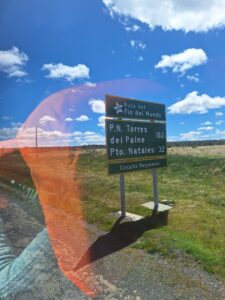
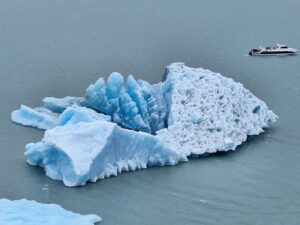
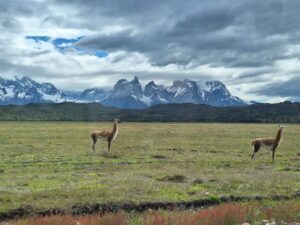
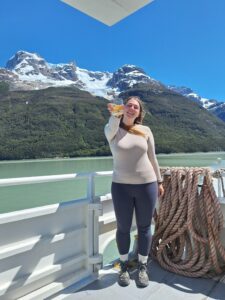
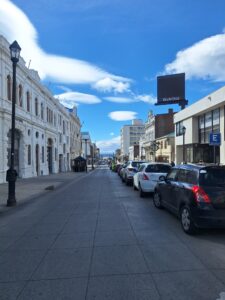
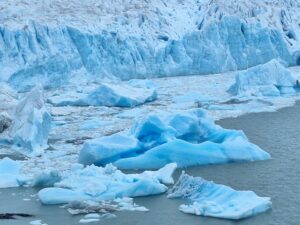
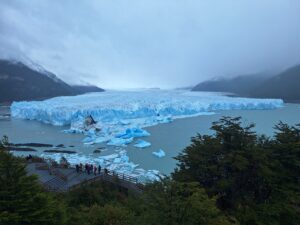
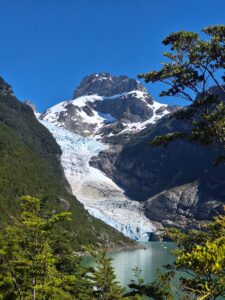
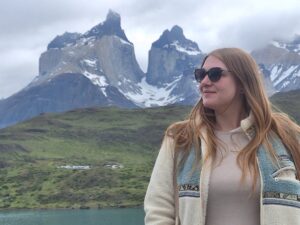
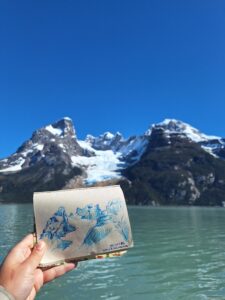
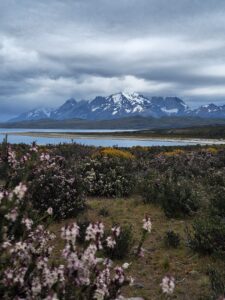
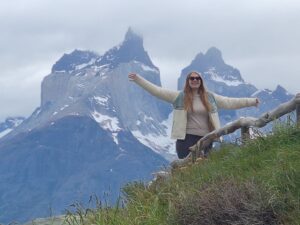
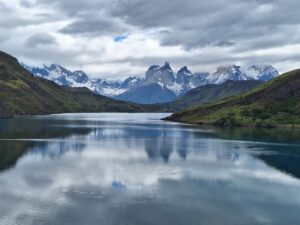
Then I take an uncomfortable night bus (so many bends) back to Santiago to catch a flight to Punta Arenas, a village in the very south of Patagonia. Punta Arenas is known for penguin tours and is my first encounter with Patagonian prices. To see penguins? At least 100 dollars. Whales? 200. That’s beyond my budget, and besides, I’ve already seen them in Peru, so I take an early bus to Puerto Natales. On the bus, I meet Chris, a Finn who is doing roughly the same route. We chat about everything and have a beer in Puerto Natales, which already looks nicer than Punta Arenas. The next day, I take a cruise to two beautiful glaciers, the Balmaceda and Serrano glaciers. During the tour, you can walk to the second glacier, get whisky with glacier ice that they fish out of the glacier lake while the tourists take photos, and enjoy an asado with lamb. We also saw waterfalls and sea lions. It was an expensive but wonderful day that I will remember for a long time, a very special experience. In Puerto Natales, I also take a tour to Torres del Paine National Park. Originally, I wanted to hike there for days, but I can still barely put any weight on my ankle. Our guide is crazy about pumas and even has a tattoo of one on his forearm. Throughout the entire trip, he and the driver keep looking around to see if they can spot one. We drive to various viewpoints overlooking the park, which are beautiful! It is a lovely park with dramatic mountain peaks. However, if you don’t do the 8-day “O-trek”, you will only see the same mountains over and over again. The O-trek is closed due to a severe snowstorm earlier that month, in which 5 people lost their lives. Unfortunately, tourists who booked the O-trek will not get their money back. More than 1000 euros per tourist goes out the window. Patagonian prices strike again… I take a bus to El Chalten, a village known for its beautiful walks. I gather all my courage to at least do a walking tour in Patagonia, even if it means a week longer of rehabilitation. I make my sandwiches, get ready to leave early in the morning and… torrential rain. The hiking trails were closed due to heavy rain and I didn’t have time to wait for them to reopen later that day because my buses and flights were already booked. Feeling a little defeated, I head to Calafate, where sunshine and cheerful people await me at the hostel. Finally, a cheerful, social place in Patagonia! Until now, everything has been cold and bleak, but here, cheerfulness seems to prevail. On my last morning, I visit the famous Perito Moreno glacier, a wide and large glacier. Occasionally, we hear and see blocks of ice crashing into the water, the dimensions of which are absurd. Until the rain strikes again, and everyone takes refuge in the cafeteria. There we wait for the driver to return and that evening I take the plane to Buenos Aires, where I will mainly be seeing friends and enjoying the city for the next few weeks. I regret having to leave Patagonia already; it is a beautiful place, but I did not have enough time to wait for the weather and my ankle to allow me to really enjoy it adventurously. I would definitely like to go back, but probably stay a little further north. Back to explore Pucon, Puerto Varas and Bariloche. That’s still on my South America wish list, along with wine tasting in Salta.